Girl, 3, dies after bouncy castle thrown into air by strong wind at church party
Six people were hospitalised after a bouncy castle and a tent were tossed into the air by strong winds at a church party in Parc Ouellet, LaSalle, southwest Montreal

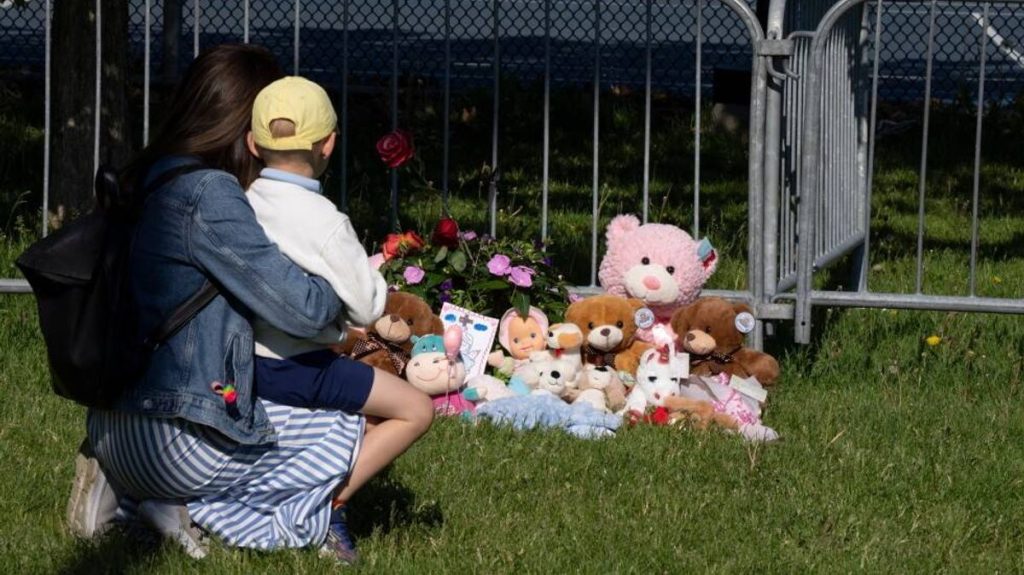
Mourners leave tributes at the site of the tragic incident(Image: AP)
A three-year-old girl tragically perished after the bouncy castle she was enjoying was swept skyward by powerful winds during a celebration at a Montreal park.
Eleven individuals sustained injuries, with six requiring hospital treatment, when fierce gusts hurled both the inflatable and a marquee into the air on May 31 at Parc Ouellet in LaSalle, southwest Montreal, Canada.
The catastrophe unfolded during a church gathering in the municipal park, as wind speeds soared to 31mph (50kph) on Sunday afternoon.
Cathy Denis, who runs an inflatable rental business in Quebec, revealed she refuses to set up or operate bouncy castles when forecasts predict winds exceeding 24mph (38kmph). She highlighted that inflatables create substantial surface areas, making them susceptible to sudden gusts that can shift the structures despite proper installation.
This marks yet another devastating incident of its kind. Back in 2022, an eight year old girl succumbed to her injuries after fierce winds launched a bouncy castle several metres airborne during a festival in Mislata, near Valencia, Spain. Eight additional youngsters were hurt, with several needing medical care.
In 2021, six children lost their lives and three others suffered critical injuries when a gust propelled a jumping castle approximately 10 metres into the sky during an end-of-term event at Hillcrest Primary School in Devonport, Tasmania, Australia. In 2017, Spanish authorities reported that a six year old girl perished and six other youngsters sustained injuries when an inflatable bouncy castle broke free from its moorings and became airborne in Caldes de Malavella, in northeastern Spain, throwing the children to the ground. Officials examined whether the incident resulted from anchoring failures or equipment defects.
Coroner Martine Lachance has been appointed to probe the causes and circumstances of the fatality. Health Canada recommends that operators of inflatable structures firmly secure them to prevent movement, overturning, or becoming airborne.
In the UK, the Health and Safety Executive (HSE) states that no inflatable should operate in winds exceeding 24mph (38kph). “When the inflatable is being operated outside, use an anemometer to measure the wind speed at regular intervals. If one of these is not available, the inflatable should not be operated outside,” the organisation states on its website.
A 2013 study released by the Public Health Agency of Canada documented 674 injuries linked to inflatable attractions recorded through the Canadian Hospitals Injury Reporting and Prevention Program between 1990 and 2009. Youngsters aged between two and nine represented the highest proportion of injuries, while fractures comprised more than one-third of documented incidents.