Webb’s IC 348 Mosaic Includes Two-Jupiter Dwarfs, Twin Jets, and a Nursery Still Making Worlds
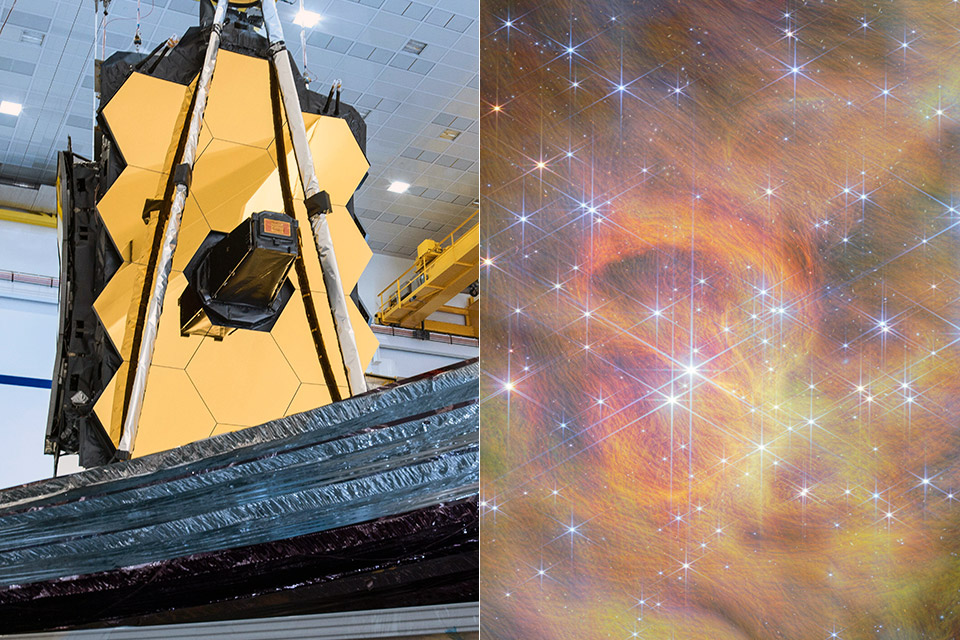
Photo credit: NASA/Chris Gunn
NASA’s James Webb Space Telescope has released one of its largest public views yet, a near-infrared mosaic of IC 348, a star-forming region 1,000 light-years away in Perseus. Cold molecular hydrogen in that cloud is still collapsing into new stars, and Webb’s NIRCam turned the scene into a wide, crowded field of young suns, leftover dust, and objects so small they sit uncomfortably close to the planet side of the ledger.
A thousand light-years apart, you can see the difference, since Webb has the resolution to detect not just the luminous cluster but also the faint stragglers lurking in the filaments. The smallest proper stars will have a mass of about 8% that of the Sun. If you have anything smaller than that growing in the same manner that our sun does, by gravity dragging a cloud in on itself, you have a brown dwarf: it can’t get hot enough internally to fuse hydrogen properly, though many of them do burn deuterium for a short time in the beginning. A 2022 hunt in this same region with Webb found brown dwarfs with masses 3 to 4 times that of Jupiter, followed by some deeper NIRCam imagery in 2024 and NIRSpec spectra in 2025 under General Observer program 4866, which lowered the floor even further. Several of the objects were discovered to weigh around twice Jupiter’s mass, or 0.19% of the Sun’s mass, making them the least massive brown dwarfs on record. That effectively negates what many of the formation models have to say on the subject.

LEGO Icons Hubble Space Telescope 11382
- EXPLORE THE HUBBLE SPACE TELESCOPE – Celebrate one of humanity’s greatest scientific feats while enjoying a relaxing building experience with the…
- REPLICA SPACE MODEL – Recreate the legendary space-based telescope with posable solar arrays and antennas, an opening aperture door and a detailed…
- AUTHENTIC DETAILS – Remove the exterior panels to reveal a detailed instrument bay, which features gyroscopes alongside primary and secondary…
The researchers behind this hunt, Kevin Luhman of Penn State and Catarina Alves de Oliveira of the ESA, undertook the legwork. They selected the candidates based on color and brightness in the NIRCam frame, then weighed them using spectroscopy. One of the lightest new objects also appears to have a disk surrounding it. That leads to a simple but scary thought: planets may be developing around an object with the same mass as a planet. The spectra of the lightest brown dwarfs also revealed another surprise, which the team believes is an unnamed hydrocarbon composed only of hydrogen and carbon. This signal is only found in the most extreme objects, prompting the scientists to consider assigning these brown dwarfs their own spectral class.
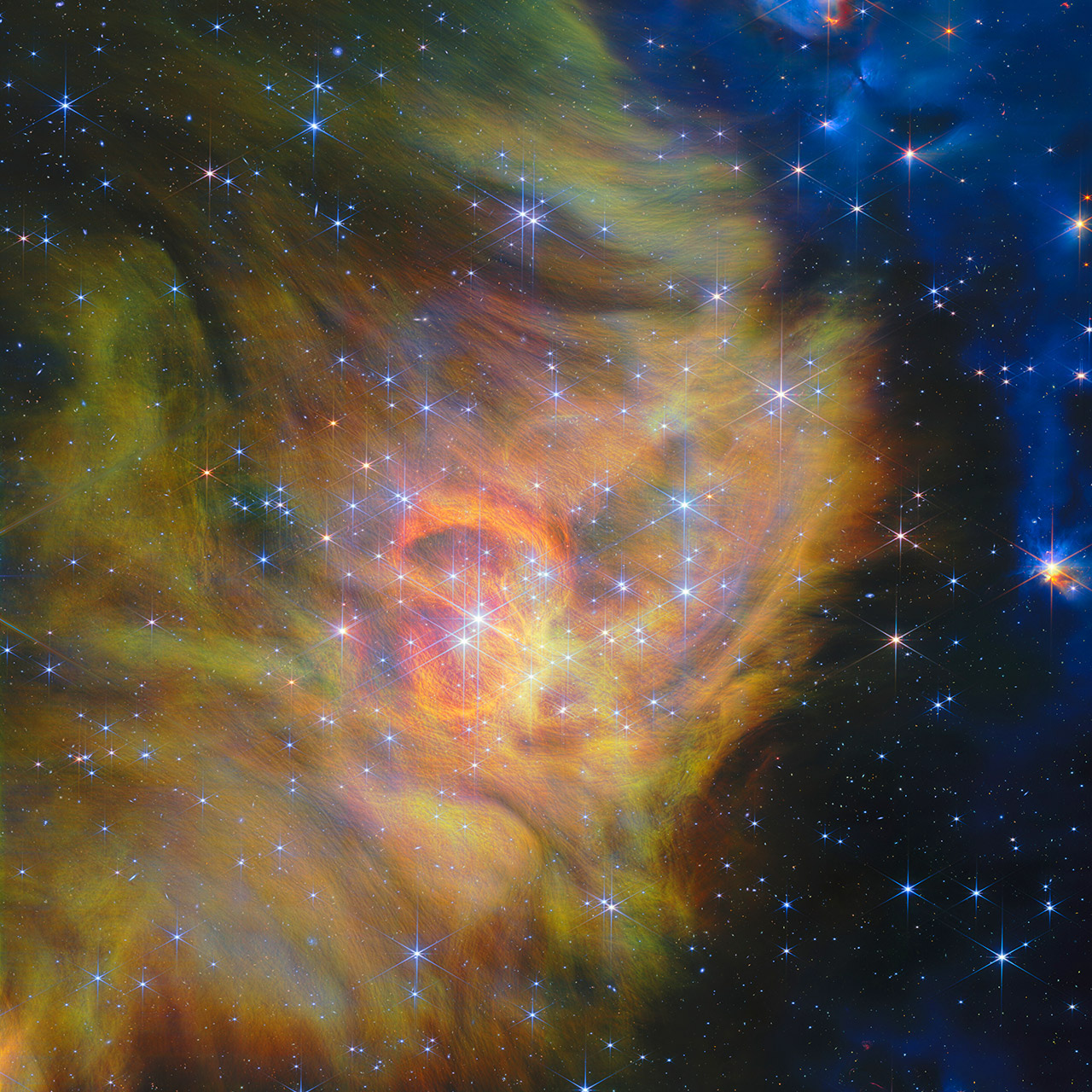
NIRCam pieced together this mosaic using filters F162M, F182M, F360M, and F444W during observations on August 30th, 2024. The resulting product is a pretty enormous image, 16 by 20 arcminutes, which ranks as one of Webb’s largest releases to date. With tens of thousands of pixels to work with on each side, it’s no surprise this image is so detailed. Because we’re gazing in near-infrared light, the dust clouds become transparent rather than obscuring the view. As a result, young stars appear all over the place, faint outflows can be seen speeding through gas, and embedded sources glow brightly from within thicker knots of gas and dust. Even more intriguing, the mosaic’s background includes spiral galaxies and a gravitational lens, indicating that Webb is seeing not only into the clouds, but also back at the nursery.
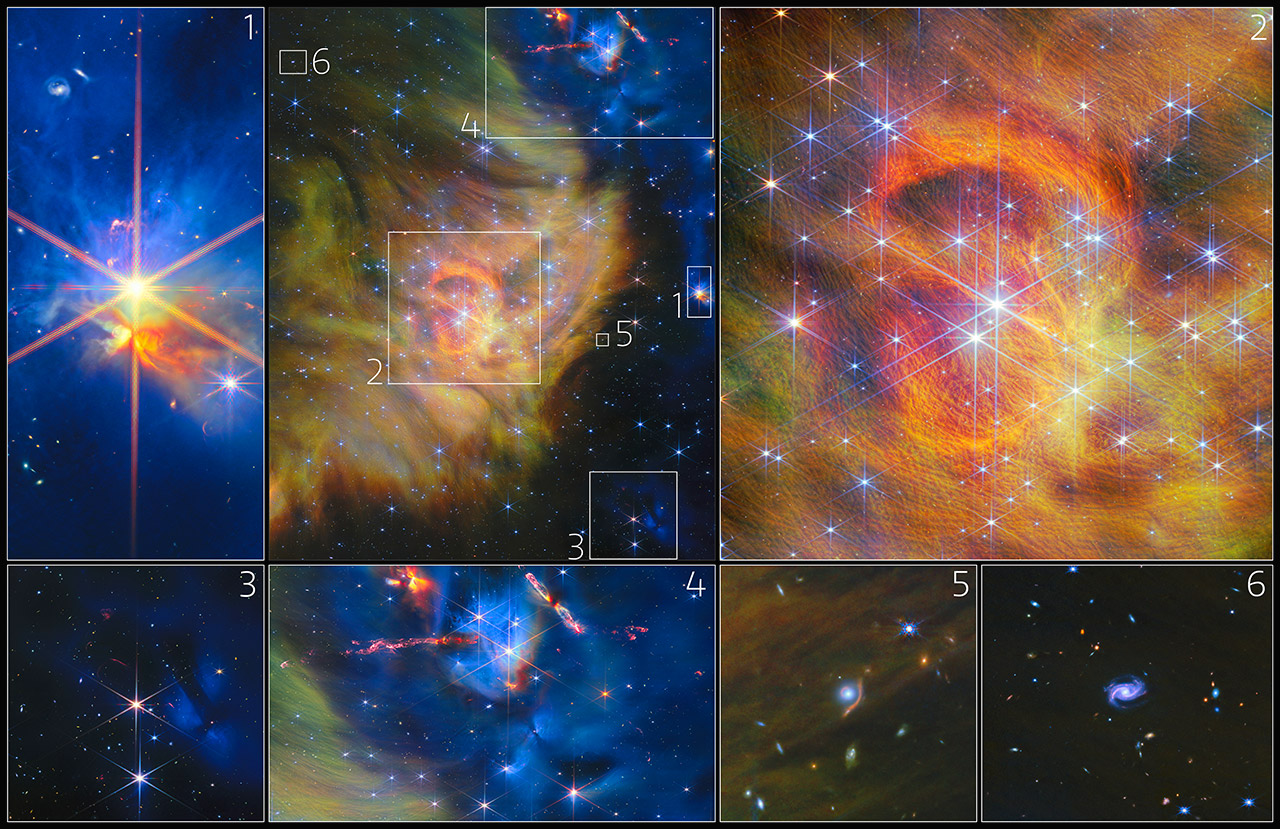
The heavy lifting is taking place in the upper right corner of the building site. A dense cluster of protostars is hard at work right there, with many of them spewing out jets that collide with remaining gas and dust, illuminating the vicinity as Herbig-Haro objects. One such object, HH 797, extends out in a long, thin horizontal line before separating into two protostars with parallel outflows. Right next to it, HH 211 has a rather unusual propeller form, with a narrow jet paired with a larger wind. Both of those objects appeared in previous Webb releases, but this new mosaic places them in context: two bright patches in a much larger factory that is still producing stars, dead stars, and possibly the building blocks of planets orbiting objects only slightly larger than Jupiter.
Webb’s IC 348 Mosaic Includes Two-Jupiter Dwarfs, Twin Jets, and a Nursery Still Making Worlds
#Webbs #Mosaic #Includes #TwoJupiter #Dwarfs #Twin #Jets #Nursery #Making #Worlds