Ignore Trump’s fight night – I’ve learnt that it’s dancing that makes a man
This Sunday, the White House will be hosting a mixed martial arts (MMA) tournament in honour of the nation’s 250th (and the president’s 80th) birthday. Managed by the UFC, the fight card will feature top fighters like Justin Gaethje and Ilia Topuria. The announcement was met with mixed responses. Some applauded the unusual move, saying that it offers an “opportunity to be inspired to live up to the best American ideals”. But others fear that it risks endorsing “our worst vices” as a nation.
Much of the debate over the upcoming fight is entrenched within broader debates about masculinity. The #MeToo movement challenged the idea that men ought to be tough, domineering, and emotionless, arguing that such “toxic” traits have adverse consequences not only for women but for men themselves. Some men argue that they are being pressured to be “feminised,” and that their more aggressive impulses are being unfairly demonised. This logic is in part what has motivated so-called “manosphere” influencers like Jordan Peterson and Andrew Tate to encourage their young male fans to take up a combat sport in order to develop discipline and confidence.
I was one of those recent “converts” who tried taking up boxing and MMA, which I did last year on the suggestion of a therapist. Peterson’s argument resonated with my own experience: having been taught as a child that I should avoid conflict at all costs, I began seeing how my repressed aggression was festering into traits that were covertly toxic. Trying out combat sports helped me begin to sort through some of the negative tendencies I developed, like being passive-aggressive and conflict-averse. Yet as much as I do believe that men should learn how to fight for exactly those reasons, I have to say that what’s helped me develop confidence, discipline, and maturity even more is learning to dance.
I’ve always liked dancing. Growing up in a Greek family, you had to learn traditional folk dances if you wanted to join the others on the dance floor at weddings – where guests would boogie all night long. In high school, my friends and I were quick to learn the latest viral hip-hop dance crazes. And I later picked up some Latin dance steps from friends in college. But it wasn’t until recently that I took up dance classes to learn salsa more formally and to try out the Levantine dabke – something I’ve been curious about since moving to a Palestinian neighbourhood. There, I’ve learnt the techniques necessary to dance with more ease and to step my moves up to a more advanced level.

Like fighting, dancing requires you to develop discipline and confidence. But it also forces you to learn to balance boldness and strength with grace and charm. To fight, you need to be attentive to the moment, watching your opponent’s every move. To dance, you have to do this and more: you have to learn to be in tune – to move in harmony – with the music and with the person or people around you.
This is especially the case in partner dances like a waltz or salsa, where the man takes the lead. He has to be confident enough to make his partner safe enough to trust his lead, while also being gentle so as not to intimidate her. He needs to listen to her body language while speaking to her with his own – which is all the reason why couples should take dance classes together.
Furthermore, dancing is fun. It fosters your taste for revelry and instils a real joie de vivre. You can’t dance without some verve, personality, or chutzpah. And it can be a great way to learn about other cultures or to plant roots deeper into your own.
Some are already picking up on how beneficial learning to dance can be: take the new trend of churches hosting social dances or the inner-city schools offering ballroom dance programmes, or the ever-present viral routines that pop up on TikTok.
When I go to dance class or out to clubs, I usually find that I’m one of the only men who wants to dance, let alone who even knows how to dance. Except for the guys who “grind” on women or who fist-pump together in groups with other men, the majority of guys at dance clubs are content with being wallflowers, nursing a drink, or doomscrolling on their phones.
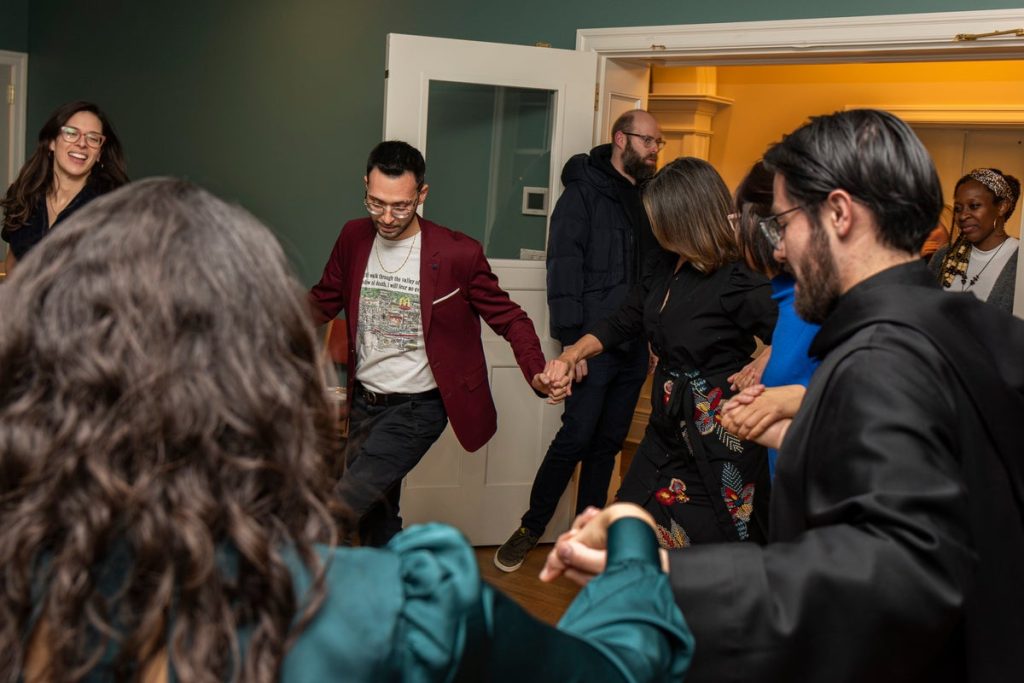
The idea that dancing is effeminate and that it’s reserved for women (or gay men) is a particularly American idea. In other cultures, not only is it normal for men to learn to lead partner dances with women, but there are certain dances reserved only for men, like the Greek zeimbekiko or the dabke. These styles, which are traditionally danced by men alone, are marked by virile and aggressive steps, as well as being spaces for men to bond without raising a single fist.

The adrenaline that rushes in when sparring or grappling is nothing short of electrifying, and it can shape the way you confront challenges in all aspects of your life. Yet the kind of electrifying, empowering feeling a man gets when he’s skilled enough as a dancer to have the confidence to approach a random woman and ask her to dance is something else altogether.
Dancing can teach a man to live not only with more discipline and confidence, but with a true passion for what he does and his interactions with others. Indeed, life itself is something of a dance, demanding us to learn to coordinate each of our steps, our encounters, with a certain harmony or grace. One can even argue that fighting is its own form of dance.
While I doubt the White House would ever host a dance-off, perhaps secretary of health Robert F Kennedy Jr might want to mandate dance requirements alongside his presidential fitness test.
Stephen G Adubato is an associate editor of Compact, an adjunct professor of philosophy and religion, and the founding editor of ‘Cracks in Postmodernity’