Hubble’s View of NGC 4449 Shows Why Irregular Dwarfs Lose Most Oxygen in GLOW
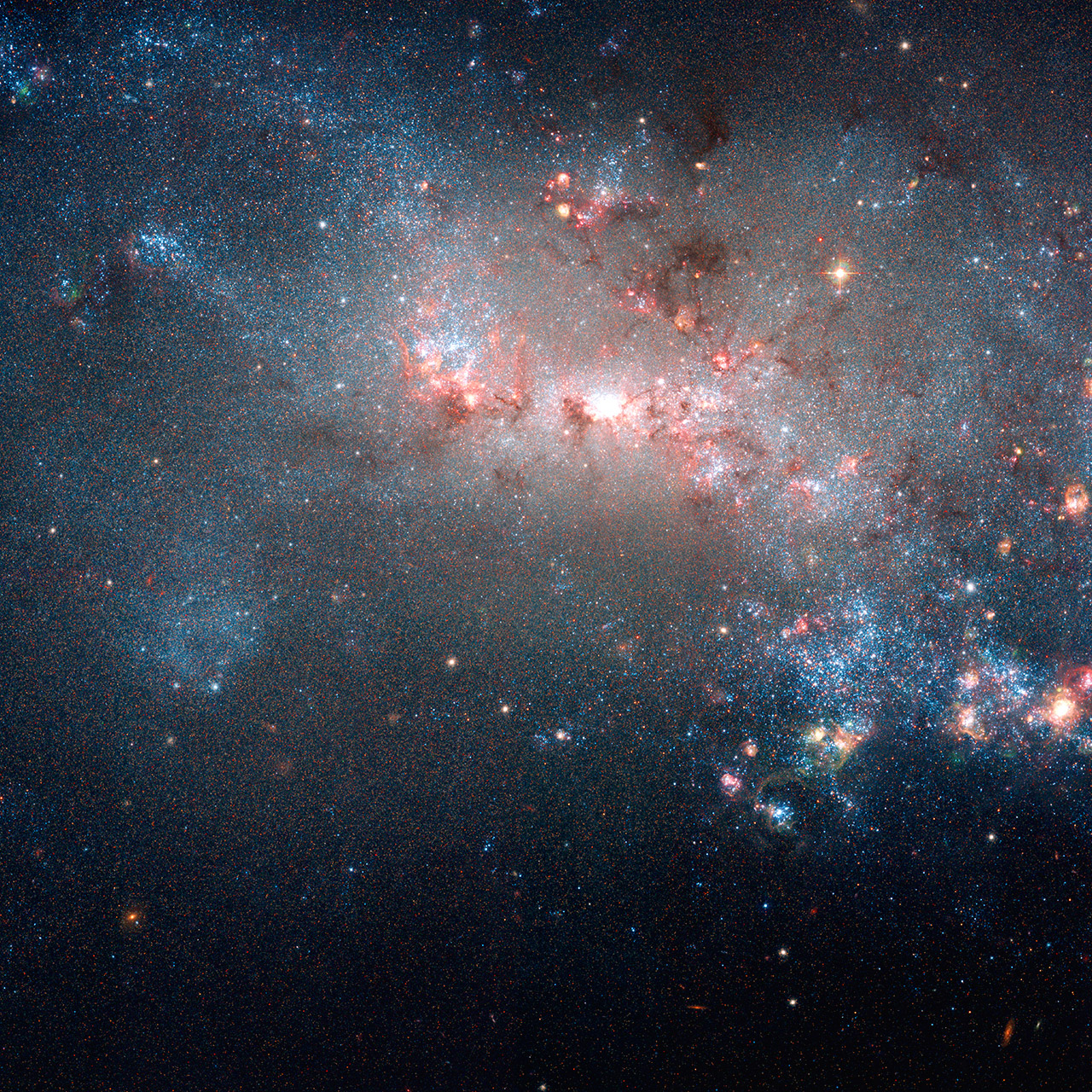
Hubble’s recent highlight of NGC 4449 places a dwarf irregular galaxy roughly 12.5 million light-years away in Canes Venatici under close scrutiny, and the object’s ragged outline does most of the explanatory work. Scattered blue-white clusters of massive stars sit next to pinkish patches of active formation and dark silhouettes of gas and dust that cut across a roughly rectangular core, producing a clumpy, cloud-like appearance rather than any tidy spiral or elliptical form.
Those features arise because the galaxy has interacted with smaller neighbors, pulling material into streams and triggering star formation across its full extent instead of confining it to a center. That is the same activity that provides us with the energy to better understand the oxygen deficiency detected in the “Galaxies Losing Oxygen via Winds” project.

LEGO Icons Hubble Space Telescope 11382 | Building Sets for Adults, Ages 18+, Space Model Decor, Home…
- EXPLORE THE HUBBLE SPACE TELESCOPE – Celebrate one of humanity’s greatest scientific feats while enjoying a relaxing building experience with the…
- REPLICA SPACE MODEL – Recreate the legendary space-based telescope with posable solar arrays and antennas, an opening aperture door and a detailed…
- AUTHENTIC DETAILS – Remove the exterior panels to reveal a detailed instrument bay, which features gyroscopes alongside primary and secondary…
Astronomers used Hubble to zoom in on individual stars in 37 nearby dwarf galaxies, then proceeded back in time to recreate each system’s star formation history, and finally calculated how much oxygen was present in the gas, stars, and dust.You know what, NGC 4449 is in that sample. Looking at the entire collection, these galaxies appear to be holding onto between 4 and 25 percent of the oxygen that their stars produced, with an average of roughly 11 percent, and the majority of the gas being left behind. Simulations indicated that we’d see a lot more of this stuff being kept onto, but the results demonstrate that there is a significant difference.
This points to massive stars and the supernova explosions that typically accompany them, which produce large outflows. These outflows are powerful enough to propel oxygen directly out of these galaxies’ shallow gravitational wells. In smaller galaxies, these winds blast even more material out than the models had projected, which implies that the majority of the oxygen that we’d expect to observe is simply not there.
On the other hand, galaxies that are more than 3.3 million light-years away from any massive neighbors tend to retain less than 15% of the oxygen produced by their stars, whereas those that are surrounded by more systems tend to have a lot more variation and sometimes manage to retain a little more. NGC 4449 has a rather disordered form and is in the middle of a massive starburst, which makes it an ideal fit for exactly the kind of conditions that would lead to this type of oxygen loss.
One of the reasons oxygen is such a useful tracer in this case is that we know exactly how much of the substance stars produce in the first place, and it is abundant enough for us to measure. Once formed, it can just sit in interstellar space, be consumed by young stars, or be absorbed into dust in many circumstances. Just disappear. The GLOW census paints a detailed picture of what is happening in these dwarfs, as the oxygen is blown out into the big unknown.
What we don’t know, and can’t figure out, is what happens to the oxygen blown out of these galaxies. Does it simply hang out in the diffuse halo that surrounds each one, or does it go through the space between the systems? The image of NGC 4449 is an excellent example of this in action, with its irregular shape revealing all of the past and ongoing interactions that are driving the star formation that fuels the winds.
Hubble’s View of NGC 4449 Shows Why Irregular Dwarfs Lose Most Oxygen in GLOW
#Hubbles #View #NGC #Shows #Irregular #Dwarfs #Lose #Oxygen #GLOW