DOOM on the Vectrex Draws a Glowing Hell on a Forty Year Old Screen
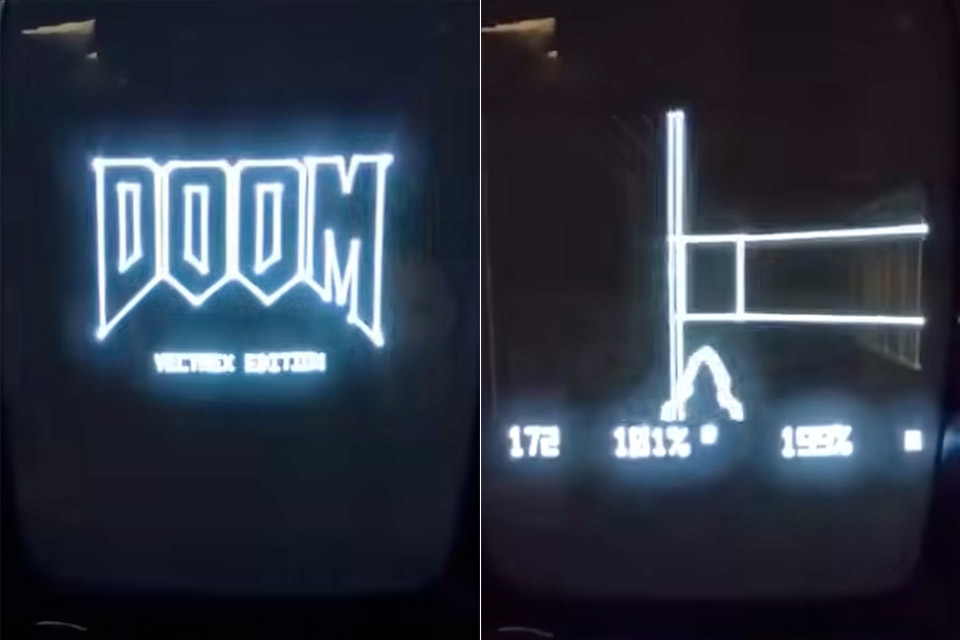
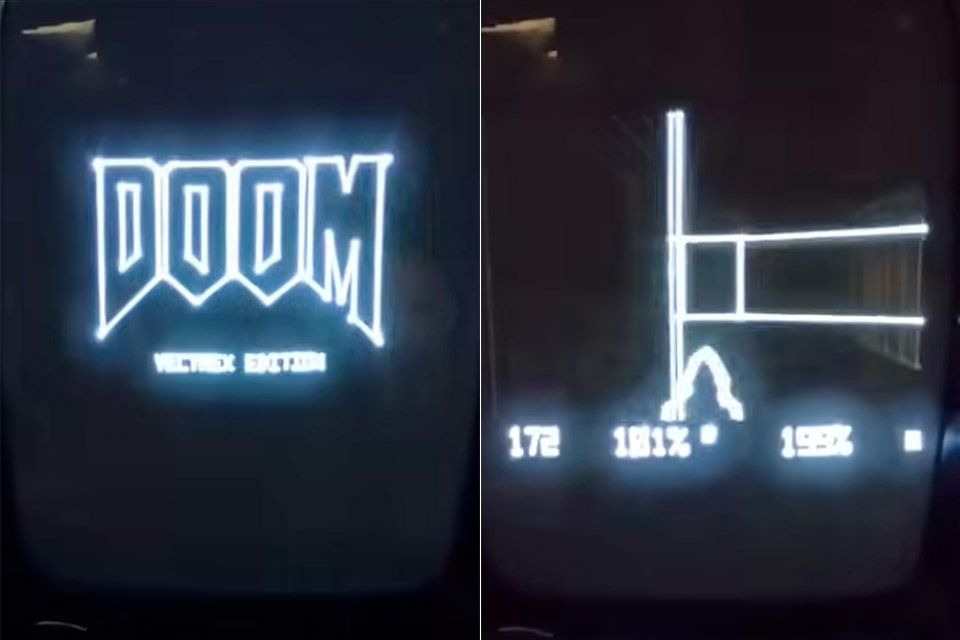
Milton Bradley shipped the Vectrex in 1982 as a complete arcade cabinet small enough for a coffee table. A screen, a speaker, a joystick, and a cartridge slot arrived in one case. Games showed up as bright strokes rather than blocks of color. Mine Storm, the pack-in, looked related to Asteroids because both were drawn the same way: an electron beam steered across phosphor, switched on for a line, switched off for the jump to the next point. Forty-four years later, footage of DOOM running on that same tube has been passing around, and the corridors of the first episode are still recognizable once the walls become thin glowing strokes.
Jason Kopp, who goes by the name Arcade Jason, posted a video online this week showing his Vectrex running DOOM with the Ultimate Vectrex Multicart 2. Playback needs the Ultimate Vectrex Multicart 2, a cartridge that behaves like a small computer seated in the slot. All of the processing takes place on that multicart, which is powered by an ARM processor, as lines are supplied to the Vectrex monitor and sound is output from a 3.5mm port on the cartridge. Kopp created this version himself, using Daniel Ferrer Guerrero’s development kit, and some of the graphics were carefully made by hand while others were generated automatically. What makes the whole thing possible is that you can simply utilize a commercial Doom WAD, such as one purchased on Steam or cloned from a disk lying around, to provide the level data.

Meta Quest 3S 128GB | Virtual Reality — VR Headset — Gorilla Tag Bundle
- CARDBOARD MONKENAUT — Get our best Gorilla Tag bundle yet with this Amazon exclusive deal. Purchase Meta Quest 3S to get exclusive items, including…
- NO WIRES, MORE FUN — Break free from cords. Game, play and explore immersive worlds — untethered and without limits.
- 2X GRAPHICAL PROCESSING POWER — Enjoy lightning-fast load times and next-gen graphics for smooth gaming powered by the Snapdragon XR2 Gen…
Anyone who owned a Vectrex already knows why the footage looks wrong and right at the same time. There is no grid of pixels or framebuffer to fill with graphics, like we see on the PC. Instead, you receive a list of lines, each of which takes some time and effort to appear on the screen because the electron gun must physically move across it. If you stick to a few hundred lines at a time, the phosphor on the screen will maintain a stable image at the console’s 50Hz refresh rate. Push past that, and you’ll notice some flickering as the beam is left behind. When you get over 800, the object starts to fade and becomes unusable. The original DOOM renderer paints in textured spans of 320 by 200 frames at a time. That just does not function on a Vectrex, therefore any version that makes it to the screen must remove the renderer while keeping the rest of the game.
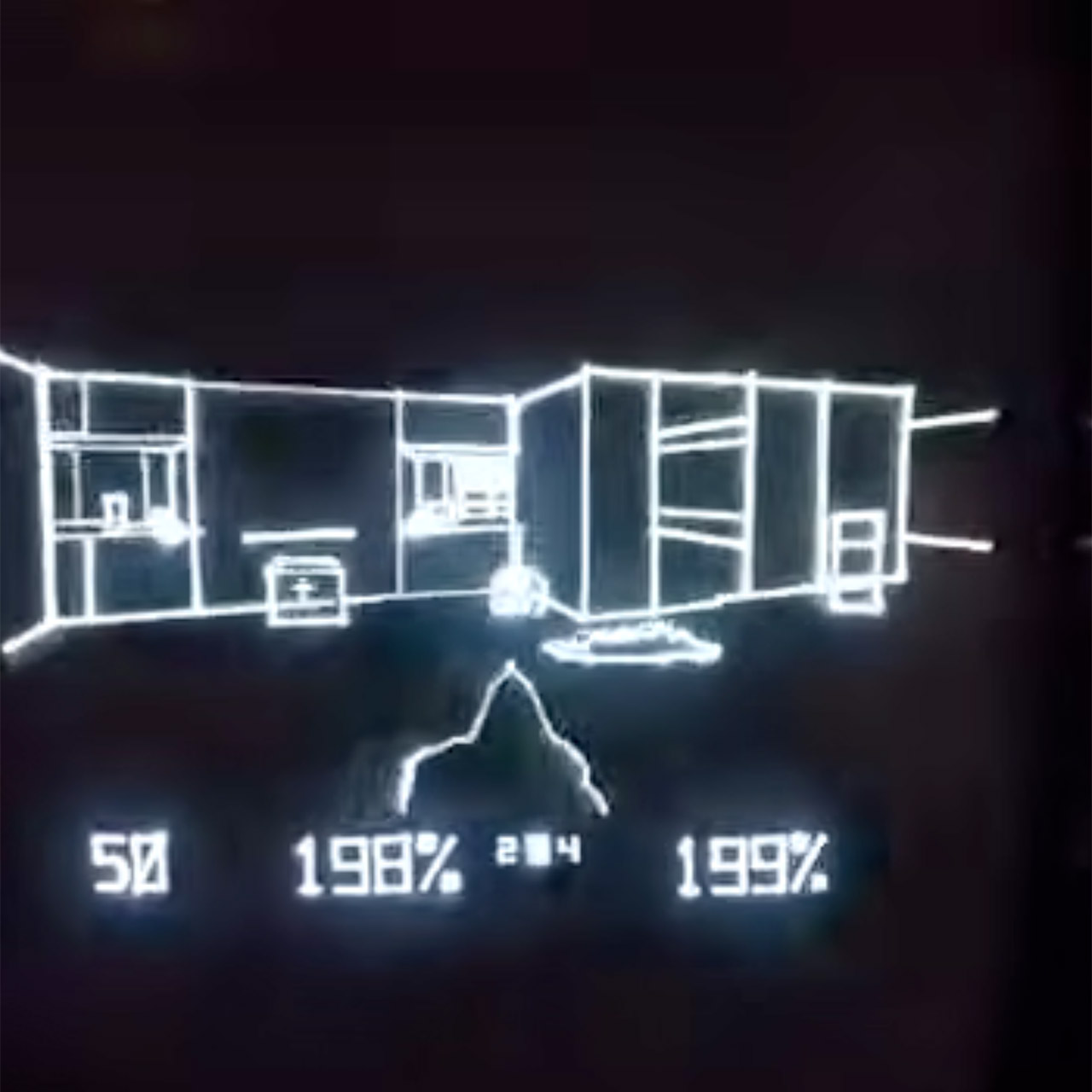
Vectrex owners have watched outsiders promise 3D on this machine before. Back in 2015, Jeroen Domburg released a small demo called voom, which was about 700 lines of code and performed a fantastic job of traversing through E1M1 and rejecting the concealed walls. His argument was that no basic Vectrex could handle the heavy lifting required to produce all of that 3D. What he created was more of a spectator, a place to explore, rather than a playable game. Malban later ported that viewer to the PiTrex, but this time is different because of the multicart slot, which allows you to execute the game logic on one side and then hand it over to the Vectrex, which will draw a basic list of lines. The Motorola 6809 in the Vectrex still lacks the cognitive abilities of the DOOM game, and the screen can only draw one line at a time. That’s the divide that allows a 1993 shareware episode to fit comfortably on a 1982 living room system, bright, minimalist, and a little mean, but yet totally at home.
DOOM on the Vectrex Draws a Glowing Hell on a Forty Year Old Screen
#DOOM #Vectrex #Draws #Glowing #Hell #Forty #Year #Screen