Hitchhikers decapitated, shot 10 times in head and buried in ‘Serial Killer Forest’
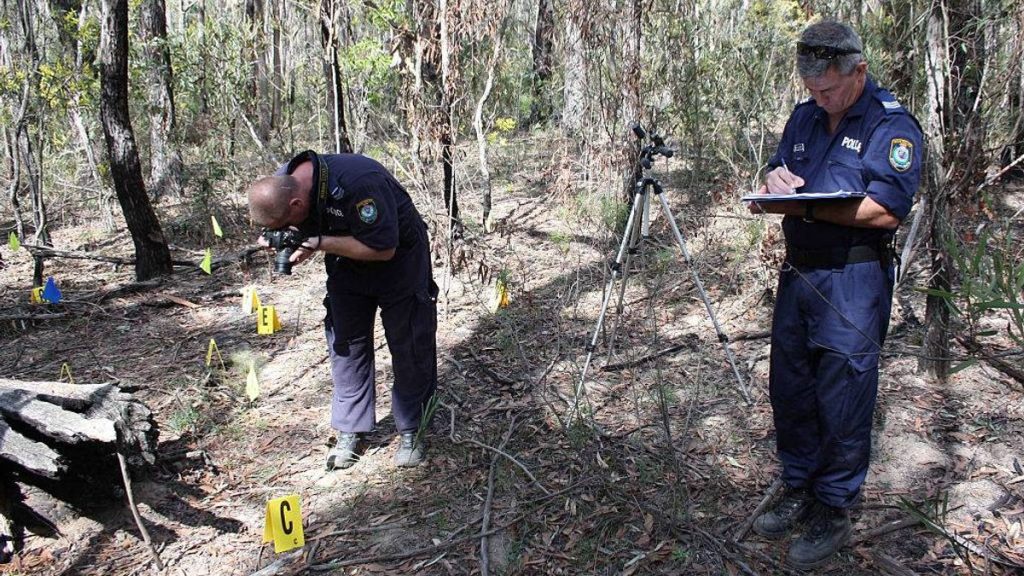
Seven bodies were discovered in shallow graves but it is believed their killer may have murdered dozens more.

How many did he kill? Serial murderer Ivan Milat took his secrets to the grave(Image: Getty)
Steven Clark considers himself fortunate to be alive today. He is convinced that he was on the brink of becoming another victim of a savage serial killer who was later found guilty of the murders of seven young men and women. As a teenager, Mr Clark and a friend were hitchhiking when a speeding car abruptly halted to offer them a lift.
“As my mate was just starting to close the door, he took off, he hit the accelerator. He hadn’t even got the door closed,” Mr Clark told ABC, noting that the driver began probing them with suspicious queries about their plans and who knew of their whereabouts.
“He was quite happy to ask us questions and begin to find out stuff about us, but he wouldn’t volunteer even his name to us,” Mr Clark said. Fortunately for the young hitchhikers, the erratic driving attracted police attention, leading to the vehicle being pulled over and the driver issued a speeding ticket.
From then, the driver’s demeanour shifted instantly and he dropped the youths off as promised — but not before Mr Clark managed to spot the initial two letters of his name on the speeding ticket, reports the Mirror US.
“It began with I, V,” he disclosed. “I didn’t get a chance to read the rest of it.”
Who was the driver?
Years later, Mr Clark was watching the news when he recognised a familiar face: “I recognised him straight away,” he recalled. The man was Ivan Milat, who had just been apprehended in relation to the murder of at least seven young hitchhikers.

Ivan Milat denied responsibility for his crimes until the day he died(Image: Newcastle Journal)

He was convicted of seven murders but is believed to be responsible for many more(Image: Getty)
Between 1989 and 1992, Milat kidnapped, assaulted, and killed seven youngsters, discarding their bodies in Belanglo State Forest, approximately two hours south of Sydney, Australia. The area subsequently earned the chilling moniker “Serial Killer Forest”.
Three of his victims hailed from Germany, two were British, and two were Australian. However, police and activists suspect that he may have been behind many more deaths dating back to the 1970s and even earlier, well before the first murder for which he was convicted.
An inquiry began this summer in Australia to explore the connections between unresolved missing persons cases and Ivan Milat. Among these is Kay Docherty, who disappeared aged 15 in 1979 while hitchhiking on the same road where Mr Clark was picked up. Her brother, Kevin, told the inquiry: “I promised my mum, who died in my arms, that I would continue the search for her daughter, my twin sister.”
Moreover, a retired British detective believes that a 20-year-old woman, Keren Rowland, was Milat’s first victim. She vanished in 1971. The detective, Hugh Hughes, stated: “If he did kill Keren, and I am 95 to 98% certain he did, then she was his first victim.”
Who were Ivan Milat’s victims?
The victims of Ivan Milat, all young backpackers, were hitchhiking between Sydney and Melbourne when they were picked up. Some travelled in pairs, others alone, but all were led into the Belanglo State Forest where they met horrific ends.

Police at the scene of the discovery of one of Ivan Milat’s victims(Image: Getty)
Their bodies were discovered between September 1992 and November 1993, buried face down in shallow graves with their hands bound behind them.
Caroline Clarke, 21, and Joanne Walters, 22, last seen in April 1992, were found by joggers. Ms Walters had been repeatedly stabbed across her body, while Ms Clarke had been shot 10 times in the head.

The Belanglo State Forest, off the Hume Highway in New South Wales, Australia(Image: Ajayvius/CC BY-SA 3.0)
In October 1993, the bodies of James Gibson and Deborah Everist, both 19, were discovered in a secluded part of the forest. They had suffered brutal beatings and stabbings. They had been missing since December 1989.
In November 1993, a skeleton was uncovered in a forest clearing by police, with two more found nearby three days later. These were Simone Schmidl and German couple Anja Habschied and Gabor Neugebauer, who had all disappeared in 1991. Ms Schmidl had been stabbed at least eight times, Mr Neugebauer shot six times in the head, and Ms Habschied was decapitated.
How did Ivan Milat manage to kill for so long without being caught?
Merely weeks following Keren Rowland’s vanishing in 1971, Milat faced charges for kidnapping and sexually assaulting two teenage hitchhikers. He escaped to New Zealand while out on bail and, despite standing trial three years afterwards, walked free when his barrister questioned the victims’ mental health records during proceedings.

Ivan Milat’s house pictured in 1994(Image: Getty)
Australian MP Jeremy Buckingham suspects Milat may have slaughtered upwards of 80 individuals. He campaigned tirelessly for the investigation (and currently leads it as it continues) and succeeded after presenting an artist’s impression of the suspected perpetrator behind the Wanda Beach killings of two youngsters, Marianne Schmidt and Christine Sharrock, in 1965, whose remains were discovered stabbed and half-buried. The sketch shows striking similarities to a youthful Ivan Milat.

Ivan Milat is arrested in 1994 in a dawn raid at his home(Image: Getty)
There’s also Peter Letcher, aged 18 when his corpse was discovered in another woodland area in 1988. He suffered a gunshot wound to the head and multiple stab wounds to his back. Ammunition found at his crime scene matched the weapon used to kill some of the young backpackers. Clive Small, who spearheaded the Milat probe, informed the BBC: “I’m satisfied the 1987 murder of Peter Letcher was Ivan Milat.”
Last year, Mr Buckingham expressed his desire for the inquiry to delve deeper and scrutinise “impediments in the justice system that impacted the delivery of justice”. He informed parliament: “I believe it is possible that Milat’s long‐term relationships with powerful and corrupt interests protected him from investigation, prosecution and justice for many decades before he was convicted for the Belanglo murders.”
He further stated: “What’s clear is that it was as plain as the nose on your face that a serial killer was operating in New South Wales in the 1970s.”
According to him, the inquiry had received “scores of stories of people who had been picked up” or had reported assaults or near-misses that were only later linked to Milat.
The ‘star witness’ who helped convict Milat
Ivan Milat might have evaded justice for his monstrous crimes if not for a British man named Paul Onions. In 1990, when Milat picked him up and he spotted a gun and rope in the car, he realised he was in danger.

Paul Onions leaves the Supreme Court after giving evidence in the trial of Ivan Milat in 1996(Image: Getty)
He managed to escape from the vehicle and was pursued and shot at by Milat before he could get into another car and rush to the nearest police station. His report was initially dismissed by local police, and it wasn’t until years later, back in the UK, that he saw news reports about the discovery of bodies in Belanglo State Forest.
He contacted the Australian Federal Police from the UK and was promptly flown back to Australia, where an investigation had already commenced. It was now 1996. Media coverage at the time hailed Mr Onions as a “star witness”, although he declined a reward offer of A$200,000 (£110,000).
What became of Ivan Milat?
Ivan Milat received seven consecutive life sentences without the possibility of parole for seven murders, in addition to the attempted murder, false imprisonment and robbery of Mr Onions. He passed away in prison in 2019 at the age of 74.

Ivan Milat being taken away from court after being found guilty of seven murders(Image: Getty)
After being diagnosed with stomach and throat cancer six months prior, authorities attempted to coax him into admitting his role in other unresolved crimes, but he remained unyielding, taking any undisclosed information to his grave. He left behind a letter for his brother, concluding with: “I am innocent of the crimes convicted of.”

In 2010, human remains were again found in Belanglo State Forest and reports linked them to Ivan Milat — but later forensic examination found the remains had been left there many years after Milat was sent to jail in 1996. These were the remains of a 20-year-old woman who had also been murdered(Image: Getty)
“He is still without peer as Australia’s worst serial killer,” remarked former detective Stuart Wilkins following his death. “It’s a real travesty the way he sat there and still denied his absolute guilt in committing those murders and others. It just goes to show his psychopathic personality to the end.”