Backpackers brutally murdered by serial killer The Serpent who is now a free man
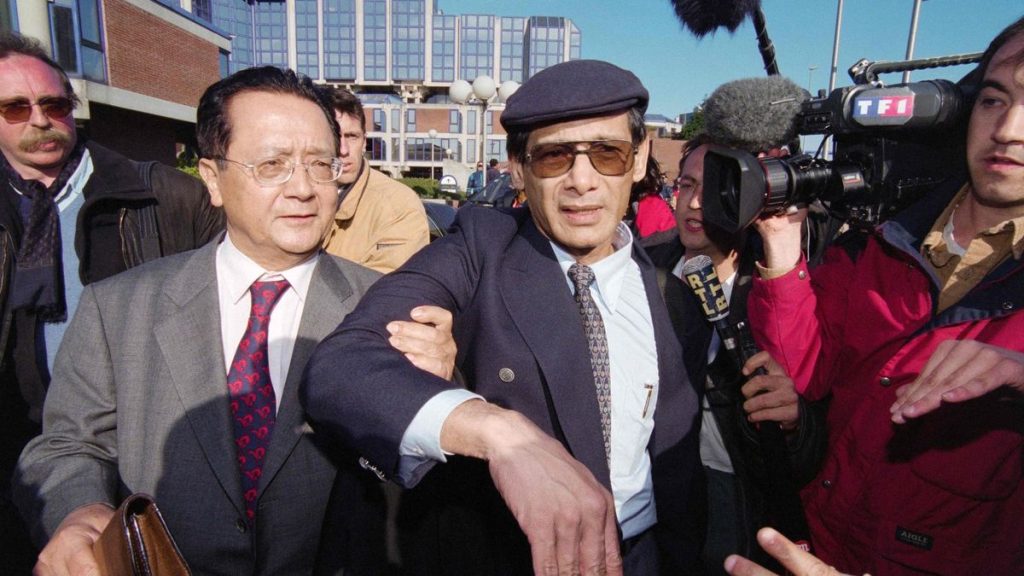
French serial killer Charles Sobhraj, 79, allegedly slaughtered at least 20 Western backpackers who were travelling through Asia during the 1970s and 1980s

Charles Sobhraj leaves a French court with his lawyer Jacques Verges(Image: AFP via Getty Images)
A sick serial killer slaughtered at least 20 travelling hikers in Asia, boasting, “I was like a shadow”.
Charles Sobhraj, dubbed ‘The Serpent’, carried out a campaign of horror in the 1970s, shocking the globe before serving just a 20-year sentence.
Sobhraj poisoned, robbed, and butchered holidaymakers journeying across Thailand, India, and Nepal, luring them in with his charisma and charm. Sobhraj was freed from a Nepalese jail in 2022 with clips from Channel 4 documentary, The Real Serpent: Investigating a Serial Killer, showing the 82-year-old strolling freely through London, pausing to take pictures of Big Ben.
The killer said he avoided arrest again and again because he was, he says, “like a shadow”.
Sobhraj was born in Saigon to a Vietnamese mother and an Indian father. He began acting out as a teenager in France and was imprisoned for the first time for burglary in 1963 in Paris, as per History Hit.
He manipulated prison wardens into providing him with special privileges, such as having books in his cell. Sobhraj was a social chameleon, moving between elite circles, and crooks, where he met his future spouse Chantal Compagnon.
On the very day he asked Chantal, a young woman from a conservative Parisian family, to be his wife he found himself behind bars for attempting to flee police while driving a stolen car, serving eight months before marrying her as soon as he was released.
Sobhraj and a pregnant Chantal escaped France in 1970, targeting holidaymakers and forging paperwork while journeying across Eastern Europe. Chantal gave birth to their daughter, Usha, in Mumbai while Sobhraj ran a car theft and smuggling ring.
Sobhraj found himself imprisoned again after he masterminded an armed heist for precious stones at Hotel Ashoka in 1973.
Nevertheless, he managed to break free by pretending to be ill, a trick he would use again and again in his criminal career, but he was quickly re-captured. After his father bailed him out, he moved to Kabul where he was imprisoned again for targeting tourists.
Once again, Sobhraj feigned sickness before sedating a hospital guard to make his escape, fleeing to Iran and abandoning his young family, who returned to France. He spent the next two years as a fugitive throughout Eastern Europe and the Middle East before reuniting with his younger half-brother Andre in Istanbul.
The pair were caught in Greece, but Sobhraj managed to swap identities with his sibling and evade arrest, leaving Andre to rot in a Turkish prison for 18 years.
This was the pivot for The Serpent – and the point he began to scale up his crimes into full-blown murder He pretended to be a drug dealer to entice Western tourists and robbed them, killing them if he thought they may expose him.
One of his initial victims, Seattle holidaymaker Teresa Knowlton, was discovered drowned in a tidal pool in the Gulf of Thailand in 1975, wearing a floral bikini. This led to the Bangkok Post calling Sobhraj the ‘Bikini Killer’ as several female victims were found dead in swimwear.
Over his campaign of violence he poisoned, drowned, and burned hikers.
Among other victims linked to him were Dutch students Henk Bintanja and Cornelia Hemker, Turk Vitali Hakim, and his French girlfriend Charmayne Carrou who was killed after trying to find her partner. Besides Thailand, Sobhraj traversed Asia with Chowdery and girlfriend Marie-Andree Leclerc, claiming victims in India and Nepal.
The three faced questioning by Thai authorities before being freed. They quickly made a run Malaysia. Sobhraj and Leclerc then travelled to Geneva to sell some of their hoard before returning to India to start a new crime gang.
It was in India where Sobhraj’s luck finally ran out when his scheme went wrong – a group of French students began losing consciousness as the substances he’d laced their drinks with took effect faster than expected. Sobhraj faced charges for murdering Frenchman Jean-Luc Solomon and received a 12-year jail term.
Upon entering the prison, he had smuggled precious stones, and used them to corrupt prison officers. Because of this, he enjoyed a luxurious life in jail. He had a television and received fine dining treatment. As his release date drew closer, Sobhraj escaped once again by hosting an elaborate celebration for the warders and sedating them with sleeping tablets.
Thankfully, he was recaptured and his sentence extended by a decade, ensuring his Thai arrest warrant would expire and he’d dodge the death penalty in Thailand. The murderer walked free in 1997 and lived in France, basking in his notoriety and wealth through numerous media appearances.
However, this apparently wasn’t enough for Sobhraj, who travelled to Nepal in 2003. After being recognised by a reporter, he was arrested at a gambling establishment and given a life sentence in November 2004 for the killing of Connie Jo Bronzich in December 1975.
Sobhraj was unsuccessful in two appeals challenging his conviction, with Nepal’s Supreme Court confirming the life sentence for murder in 2010. A Nepalese court subsequently found him guilty of Laurent Carriere’s killing in December 1975, resulting in an additional 20-year term which he chose not to contest in 2014.
Despite Thai authorities issuing an arrest warrant in 1976, Sobhraj has avoided returning to Thailand and remains untried for his alleged offences there. While only convicted for two killings, he left behind numerous other victims and has travelled the world, financing his travels through profits from his life story.
Former Det Ch Insp Jackie Malton described Sobhraj told the The Mirror he is a “horrible man”. Commander Gary Copson said: “No way would I accept a cup of tea from him, put it that way. Yes, he’s 79. But he’s not a decrepit 79. He’s still got his marbles, he is capable. He has always had women doing his bidding. It would astonish me if he had not convinced one or more women, even now, that he was a safe and entertaining companion.”
Marie-Andree Leclerc was Sobhraj’s most devoted follower, and had a romantic obsession with him. The Quebec-born Canadian met the killer during her travels through India and abandoned everything to be with him.
She managed to evade authorities for years using fraudulent documentation before finally being apprehended in India in 1976.
Both received 12-year sentences in 1980, though Leclerc successfully challenged the verdict and secured release under the stipulation she remained within Indian borders.
She published a memoir titled Je Reviens, meaning “I will be back”, presenting her version of events while denying any genuine affection for Sobhraj. Following her ovarian cancer diagnosis in 1983, Leclerc was allowed to return to Canada.
She died of the disease at her Quebec home in 1984, aged just 38.
Herman Knippenberg was the Dutch diplomat who uncovered Charles Sobhraj’s horrific crimes in Thailand. While investigating the vanishing of two Dutch tourists, Henk Bintanja and Cornelia Hemker, Herman discovered they had been killed and wrongly identified as Australian backpackers.
Herman gathered a wealth of evidence against Sobhraj and built the case against him from the ground up. He went far beyond his official responsibilities by actually entering the killer’s flat to gather evidence and maintained extensive files which were ultimately used to bring the murderer to justice.
Herman and his wife Angela Knippenberg departed Thailand in 1977 and divorced in 1989. Herman pursued his diplomatic career, working at missions across the globe, and now lives in New Zealand with his new partner Vanessa.